Europe · GeoGuessr
How to recognise Belgium in GeoGuessr
What gives Belgium away in Street View: licence plate, road signs, bollard, flag and script. Plus the quick facts: driving on the right, domain .be, calling code +32.
- Driving side
- right
- Domain
.be- Calling code
+32- Capital
- [object Object]
- Languages
- German, French, Dutch
- International vehicle code
B- Word for “street”
- Rue · Straat
- Road lines
- Mostly white lines; often marked cycle lanes along the edge, and narrow roads may lack a centre line
Open Belgium on Signlore → All countries
Licence plate
Dark red text and red border on white, EU band 'B', pattern 1-ABC-123. Unmistakable.
Plates are drawn by Signlore after real ones; the number is made up.
Road signs


- Pedestrian crossing sign (F49) has no zebra stripes: two horizontal dotted lines, and the figure has a square head (France/Netherlands: zebra stripes).
- Priority road diamond is orange-yellow and much smaller than in other countries.
- Town entry sign is white with a black border and the municipality name in bold black.
- Chevrons are white with a red arrow (same in the Netherlands, not in France).
- Small additional plates are often blue (elsewhere usually white); sign posts and sometimes sign backs are orange – unique to Belgium.
- Flanders: warning signs almost always have a thick red border without a white outer rim (like Spain); Wallonia mostly has a thin white rim. Direction signs are blue or white.
Sign images: Wikimedia Commons, licence on each image (hover). Bollard pictures: own renders.
Bollard
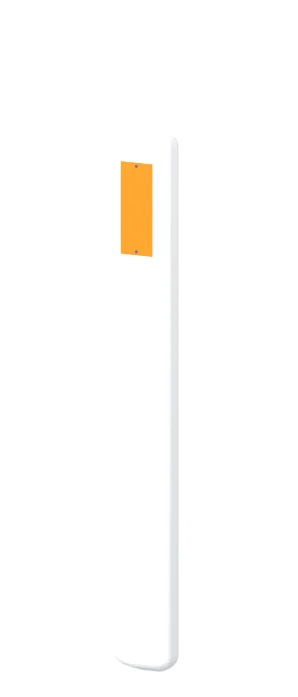
White delineator with a triangular cross-section and a rounded, sloped head, no band; orange reflector right below the head, a colourless (white) one at the back. Also newer posts with a black head.
Flag
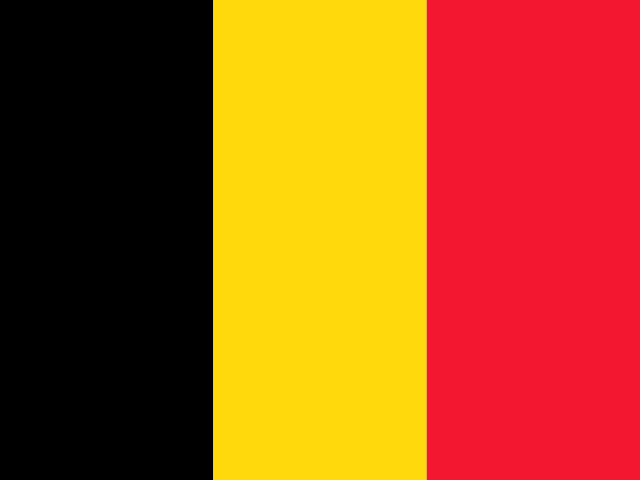
Black, yellow and red are the colours of the Duchy of Brabant. During the 1830 revolution the stripes were first horizontal; in 1831 they turned vertical.
Officially it has an odd, almost square 13:15 ratio, though 2:3 is far more common. Unlike Germany's, it's vertical and true yellow rather than gold.
Language & script
Dutch
ij · aa · oe · Uitrit · Fietspad · Straat
Double vowels (aa, ee, oo) and ij; the same in Flanders (northern Belgium), Wallonia is French-speaking
French
é è ç · à · œ · Rue · Sortie · Cédez le passage
ç, œ and accents; 'Rue', 'Sortie'. Belgium/Switzerland bilingual; West Africa (Senegal, Ivory Coast, Mali) French; Tunisia with Arabic, Madagascar with Malagasy
Often confused with
Plate: Belgium has white plates with dark red text, the Netherlands all-yellow ones
Sign: Belgium's pedestrian sign shows two dotted lines instead of zebra stripes
Bollard: Belgium has an orange reflector, the Netherlands a long dark red one
Plate: Belgium has red text on white, France black text and a blue band on the right
Sign: Belgium's pedestrian sign shows two dotted lines, France's zebra stripes
Bollard: Belgium has an orange reflector, France usually a wide red band
Practise Belgium on Signlore
- Area codes – Nine-digit numbers: 02 Brussels, 03 Antwerp, 04 Liège, 09 Ghent, otherwise three-digit zones – mobile numbers (04xx) are not regional
More countries in Europe
 Åland
 Albania
 Andorra
 Austria
 Bosnia and Herzegovina
 Bulgaria
 Croatia
 Cyprus
 Czechia
 Denmark
 Estonia
 Faroe Islands
 Finland
 France
 Germany
 Gibraltar
 Greece
 Hungary
 Iceland
 Ireland
 Isle of Man
 Italy
 Jersey
 Kosovo
 Latvia
 Liechtenstein
 Lithuania
 Luxembourg
 Malta
 Monaco
 Montenegro
 Netherlands
 North Macedonia
 Norway
 Poland
 Portugal
 Romania
 Russia
 San Marino
 Serbia
 Slovakia
 Slovenia
 Spain
 Svalbard and Jan Mayen
 Sweden
 Switzerland
 Turkey
 Ukraine
 United Kingdom